Content Marketing for Nonprofits: Storytelling That Drives Impact
Posted by: Carl Jones
May 1, 2026
In the middle of the night, Paula sat on her couch, phone in hand, trying to decide whether to make a $100 donation.
Earlier that evening, she had come across two posts from the same nonprofit. Before going to bed, she found herself thinking about them again, scrolling back to decide.
The first post contained several “standard” indicators of effectiveness and success.
For Example:
- This month alone we served 3,000 meals
- We will expand into two new communities
- Our success rate of our programs increased by 22%
She paused for about two seconds… and kept scrolling.
The 2nd post stopped her... She clicked. She read. She donated!
The second post consisted of nothing but a simple photo of a man sitting on a curb with a paper cup of coffee in his hand. The photo had one simple caption: “I used to sleep right there. Tonight, I have a bed.”
This moment is indicative of how people behave online, and why content marketing for nonprofits must focus on connection over information, especially when building a cause-driven content marketing approach that resonates emotionally.
According to the Stanford Graduate School of Business, a person is
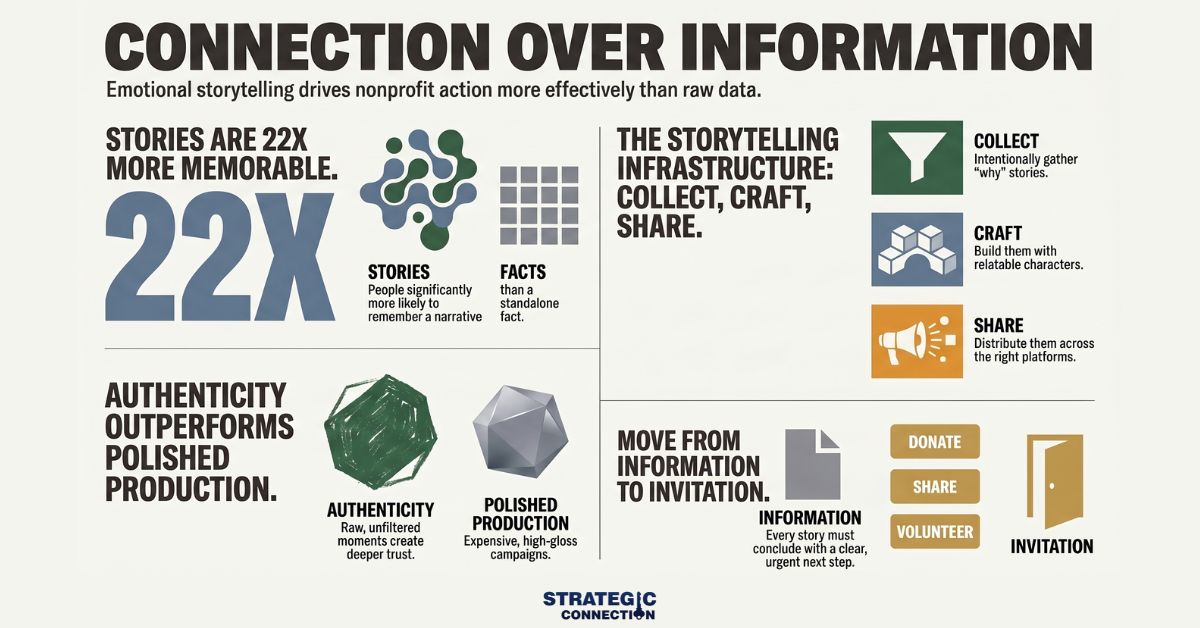
22 times more likely to remember a story than they are to remember a standalone fact.
A study published by Harvard Business School indicates that people are significantly
more likely to make a donation if they have an emotional connection to the organization or person requesting the donation.
One message informed the reader; the second message connected to the reader.
Connection leads to action!
In this article, we will cover everything you need to know about nonprofit brand storytelling.
Table of Contents
Why Nonprofits Should Utilize Storytelling in Their Content Marketing
Storytelling has survived every shift in technology, from cave walls to TikTok, because it is how we process reality. Research shows that stories engage multiple regions of the brain, especially those tied to emotion and memory. When people hear a story, they don’t just understand it, they experience it.
Standalone data points are less effective when trying to move people to act. Stories are easier to understand, easier to remember, and far more likely to influence behavior.
For nonprofits, that is everything.
While data builds credibility, it does not create urgency or connection on its own. You might respect an organization because of its numbers, but you donate because something about their story stayed with you.
This is where content marketing for nonprofits separates average campaigns from impactful ones and where nonprofit brand storytelling becomes a critical differentiator.
Content production is easier than ever, largely due to AI. But AI cannot replicate lived experience. It cannot stand in a shelter, connect with a volunteer, or witness transformation in real time.
Your stories are your fingerprints; this is what transcends all of the noise and gets your message across, and why a strong nonprofit content strategy must prioritize storytelling within a broader nonprofit blog marketing framework.
Infrastructure for Modern Nonprofit Storytelling
The best storytelling is not random. It is intentional.
A simple framework works best: Collect, Craft, Share.
Step One: Collect Stories with Purpose
Start with the reason behind your work.
Too many organizations focus on what they do and how they do it without connecting back to why it matters. That connection is what resonates with supporters.
You also need to understand your audience. What motivates them? What do they care about? What misconceptions do they have?
Use that insight to collect stories that answer those questions and strengthen your cause-driven content marketing efforts.
Step Two: Craft
Every strong story includes a few key elements:
- A hook that captures attention
- A relatable character
- Stakes that create tension
- Details that make it real
Balancing credibility, emotion, and logic makes the story stronger. Without those elements, the story loses impact.
Step Three: Share Stories Where They Matter
A story is only effective if it reaches the right audience.
Your website is your foundation. Email builds connection. Social media expands reach. Video creates engagement.
There is no single perfect platform, only the right one for your audience.
This is where content marketing for nonprofits becomes a strategic advantage rather than just a tactic, especially when paired with a well-executed nonprofit content strategy.
Comparative Nonprofit Storytelling Examples
Empathy-based storytelling continues to dominate. Many organizations now share real, unfiltered stories from individuals using a human-centered approach.
Short-form video has become one of the most effective formats. Nonprofits are using quick, raw videos to show real moments rather than polished productions.
Community-driven campaigns are also growing. Encouraging supporters to share their own stories creates exponential reach and supports scalable nonprofit blog marketing initiatives.
Trust-building stories from donors and volunteers are another powerful tool. These stories provide social proof and show why people choose to get involved.
Types of Stories You Should Share
There are three primary types of stories every organization should focus on:
- Beneficiary Stories (Impact)
These show transformation and highlight real outcomes.
- Donor and Volunteer Stories (Social Proof)
These explain why people choose to support your organization.
- Staff and Insider Stories (Credibility)
These show the people behind the mission.
Micro-stories also can be incredibly effective. Sometimes, a single sentence can create more impact than a long paragraph, especially within a structured nonprofit brand storytelling strategy.
Turning Stories Into Action
A great story is only half the equation.
You need to connect the story back to your mission and clearly explain why it matters. Always include a clear next step.
Create urgency without being manipulative. People can tell the difference between being invited and being pushed.
Tell them exactly what to do next. Donate. Share. Volunteer.
This is where strong content marketing for nonprofits drives real results and reinforces effective cause-driven content marketing execution.
Best Locations for Storytelling
Website
Your primary hub for storytelling.
Email
Personal, direct, and highly effective.
Social Media
Short, emotional, and visually engaging.
Video
If you have the budget, invest here. Video brings your mission to life by showing real moments and emotions. It doesn’t need to be polished, just authentic. A simple, genuine clip can create connection in seconds.
The Future of Content Marketing for Nonprofits
Content marketing will continue to evolve, but storytelling will remain at its core.
AI will scale content production, but human stories will stand out. Authentic, raw content will outperform polished messaging. Community-driven storytelling will continue to grow.
Ethical storytelling is no longer optional. It is expected.
Organizations that embrace this shift will see stronger engagement and deeper trust.
Ready to Turn Your Stories Into Real Impact
Storytelling connects your mission to the people who care about it.
But knowing that and actually doing it well are two different things.
At Strategic Connection, we partner with organizations to turn ideas into content that drives real engagement and action, from written stories to design and video.
If you’re ready to turn attention into impact, call 800-383-0515 or explore our full range of services here: https://strategicconnection.net/services
Let’s build something that moves people.