
When Should a Business Invest in a Custom Website?
Posted by: Carl Jones
November 9, 2026
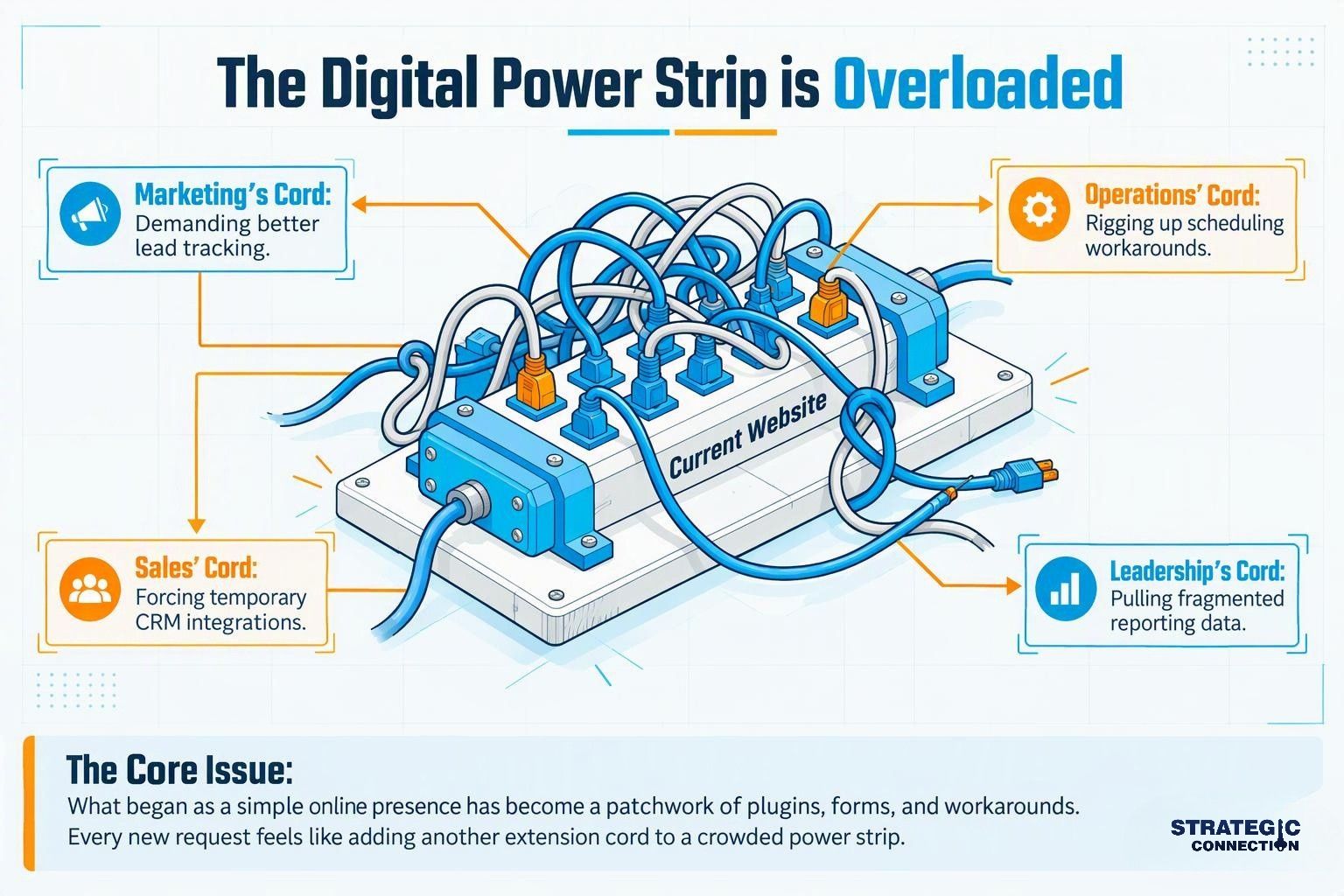
There comes a point in the life of most growing businesses when a website that once felt like a smart investment starts resembling a collection of temporary fixes. What began as a simple online presence becomes a patchwork of plugins, forms, integrations, and workarounds that nobody fully understands. The site still works, but every new request feels like adding another extension cord to an already crowded power strip.
Different departments want different website functions. Marketing wants better lead tracking, sales wants CRM integration, operations wants scheduling, customers expect self-service, and leadership wants reporting. The website has become a critical business tool, but it is still operating like a digital brochure. That is usually when custom website development deserves a serious "looking at".
Start With the Business Problem, Not the Design
One of the biggest misconceptions about custom website development is that it is primarily focused on design aesthetics. Although an appealing look is important, having a cool new homepage does not automatically lead to tangible business benefits all by itself. The question is not, “Do we need a new website?” The better one is, “What problems is our current website creating?”
If visitors cannot find information, employees repeatedly move data between systems, or customers abandon a confusing process, those are business problems. The strongest website investments remove friction from revenue, service, and operations. Google’s Search Central documentation offers guidance for organizing websites so search engines can access and understand their content.
The Evolution of Website Growth
Most corporate websites go through three common stages. Stage one is a basic website that’s all about its trustworthiness and vital information. Stage two is a content-driven website that is created through a CMS platform like WordPress, Shopify, Wix, or Squarespace. These options may be enough when the company’s content and the buyer journey are rather uncomplicated.
The third stage begins when the website becomes a part of the company’s infrastructure. For instance, the website can manage all the information about clients, connect to the database, implement certain rules of ecommerce, automate handovers, etc. At that point, it is more than just a design improvement and often requires custom website development.
When the Customer Journey No Longer Fits a Template
Templates are manufactured for the masses, while developing companies have needs that are more complex than the average ones. For example, a consulting company receives visitors with the aim of getting either a strategy, implementation, or help with ongoing maintenance. Custom web design services can help create a customer journey that better reflects the different reasons people visit a business website.
On the other hand, a custom business website can give visitors the ability to navigate based on their intention. This is not personalization just for the heck of it. It is about helping people complete the task that brought them to the site. The Nielsen Norman Group usability resources provide research and guidance for designing around how people use digital interfaces.
When the Website Needs to Connect With the Business
When a business finds itself relying on employees to serve as the integration layer, then it is undoubtedly time for the business to reconsider its current website. This is evident when a customer fills out a form, one employee copies that form to a spreadsheet, another employee copies the relevant details to the company’s CRM system, and the sales department has to type in all notes. Each step creates inefficiency in the process and places an additional burden on employees.
Custom website development can be utilized to integrate CRMs, scheduling systems, customer portals, inventory systems, marketing systems, and payment systems. The purpose of custom web development is not to enhance complexities, but rather to reduce manual labor. Businesses often benefit from professional web development when multiple departments rely on the same website infrastructure.
When E-commerce Growth Creates New Challenges
An e-commerce business can start small, with a few products and a single type of customer, and eventually expand to include subscriptions, wholesale pricing, personalized products, international markets, and other complicated tasks. However, eventually, the e-commerce website will have to do a lot more than just providing a shopping cart.
The ecommerce research carried out by the Baymard Institute includes studies on product search, mobile experience, cart behavior, and checkout usability. These studies can aid in leading the discussion from subjective taste to customer behavior. The use of custom website development can be warranted in cases in which the company’s standard templates cannot meet the requirements of the business.
When Performance, Accessibility, and Scale Matter
Websites repeatedly modified can become slower and harder to maintain. Google’s Core Web Vitals guidance explains metrics related to loading performance, responsiveness, and visual stability. A custom solution does not guarantee speed, but it can provide greater control over code, architecture, third-party scripts, and maintenance. Custom web design services can also give growing businesses greater flexibility when performance and scalability become priorities.
Accessibility should be planned simultaneously. The WCAG 2.2 standard provides testable recommendations for accessible web content. The W3C also publishes a business case for digital accessibility, while the U.S. Department of Justice provides guidance on web accessibility and the ADA. Building accessible components into the foundation is more durable than treating accessibility as a final patch.
Invest in Capability, Not Novelty
The best websites do not originate because of the latest trend in web design. They happen when there is a clear understanding of specific customers’ needs related to improvement of sales, service, operations, online commerce, reporting, or general customer experience. If an appropriate CMS fulfills those expectations, taking a simple approach is the best path to choose. But if workarounds require too much manpower, it may be more rational to turn to custom website development.
Whenever a project is proposed, it is crucial to know what capability should be developed, what systems should be integrated, which problem will be solved for customers, and what criteria will be used to measure success. On the other hand, a custom business website can give visitors the ability to navigate based on their intentions.
Ready to Explore Your Options?
Whether you are considering a redesign, a scalable CMS, or custom website development, Strategic Connection can help you evaluate the right approach. Visit strategicconnection.net or call 800-383-0515 to schedule a consultation and discuss how a better website can support growth and customer experience.